One of my favorite questions to ask is not, What happened?
I have always preferred, What is actually going on here?
That question has moved through my journals, songs, poems, books, essays, memories, relationships, spiritual and cultural investigations, and private attempts to understand my own perception. The same concern always returns: Am I seeing clearly? What is shaping what I see? What am I mistaking for reality? What is being hidden, distorted, inflated, performed, inherited, projected, or repeated without my conscious awareness?
For a long time, I thought this was just personal. A private obsession with truth, meaning, and the instability of human understanding. Since I was a child, I have always been fascinated by perception itself and by how often what we think is real can become misaligned with reality.
Over time, I realized that this lifelong investigation had a name.
I call it Reality Alignment.
Reality Alignment is the ongoing effort to bring perception, understanding, and action into closer correspondence with reality while continually reducing the distortions that separate us from it.
I have also come to see that this is not just a personal concern. It belongs to the moment we are living through. We have entered an age in which reality is becoming harder to encounter directly.
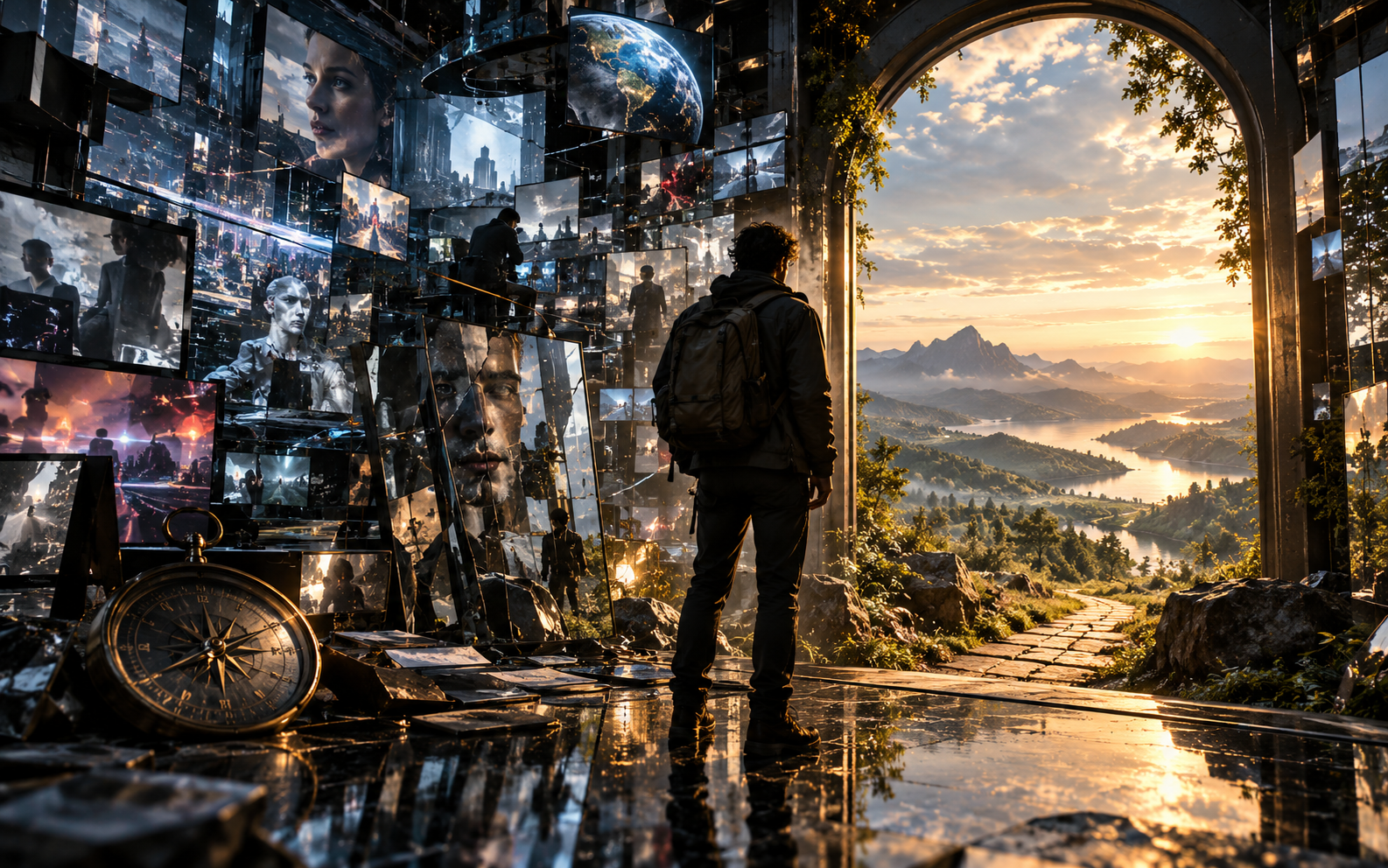
That may sound dramatic, but it is increasingly ordinary. Large portions of our lives now unfold inside symbolic environments rather than physical ones: social media, algorithmic feeds, digital identities, political narratives, online communities, synthetic images, generated language, information ecosystems, and personalized realities shaped by systems most people never see.
We no longer simply encounter the world. We encounter interpretations, arguments, performances, and simulations of the world before reality itself has even had a chance to reach us.
This changes the human condition.
For most of history, a much larger proportion of everyday life could be verified through direct experience. If someone said the bridge had collapsed, you could walk to the bridge. If they claimed the harvest had failed, you could see the empty fields. If rain was predicted, the sky eventually answered the question. Direct experience did not eliminate misunderstanding, but it often provided opportunities to test claims against reality.
Today, an increasing share of what we know comes to us indirectly. None of us can personally verify most of what we know. We learn about wars we will never witness, elections we cannot personally observe, scientific discoveries we cannot replicate, economic trends we cannot independently measure, and events occurring thousands of miles away. We depend on photographs, videos, institutions, algorithms, experts, journalists, databases, and increasingly, artificial intelligence.
This is precisely why Reality Alignment matters now.
We necessarily depend on other people. That dependence is not inherently a problem. Modern civilization would be impossible without it. But how do we evaluate those dependencies?
The challenge is that every layer of mediation also creates another opportunity for distortion. The farther a claim is removed from direct experience, the more important it becomes to understand how trustworthy the chain of evidence really is.
The challenge of the twenty-first century is not simply acquiring information. It is learning how to remain oriented toward reality when our relationship to reality is increasingly mediated by systems we cannot directly inspect. Artificial intelligence changes the evidentiary value of digital media itself. Images, audio, and video can no longer be assumed to document reality simply because they appear convincing.
Today, perception itself has become economically valuable.
Attention, emotion, identity, narrative, and belief are also valuable.
Human perception has become one of the most contested resources on Earth.
This is why distortion matters now.
Not as a philosophical curiosity, but as survival.
A person who cannot distinguish signal from noise, reality from narrative, experience from interpretation, observation from projection, or coherence from truth becomes increasingly vulnerable to manipulation. This vulnerability is not limited to politics or media. It enters relationships, spirituality, identity, sexuality, community, morality, and self-understanding. It shapes what people fear, defend, desire, imitate, condemn, and call truth.
At the same time, many of the old structures that once helped orient human beings have weakened. Religion, community, shared myth, local identity, family continuity, and civic institutions no longer hold the same organizing power they once did. Whether this is good or bad is not the only question. The immediate reality is that many people now inherit fewer stable frameworks while facing more information than any generation before them.
People know more.
People often understand less.
Information has expanded faster than our ability to metabolize it. That creates a hunger many people can feel but cannot always name. Most people are not consciously searching for Reality Alignment.
They are experiencing the pain of its absence.
They feel overwhelmed, fragmented, manipulated, exhausted, polarized, lonely, uncertain what to trust, and unsure how to remain grounded in a world that continually pulls their attention away from direct experience.
This is where my work begins to make sense to me in a new way.
I once thought I was writing about many different subjects.
Identity.
Belief.
Narcissism.
Pornography.
Addiction.
Racism.
Fascism.
Violence.
Masculinity.
Autism.
Spirituality.
Honesty.
Embodiment.
Goodness.
Truth.
Consciousness.
Artificial intelligence.
On the surface, these subjects appear scattered.
But I no longer think they are.
Most authors choose a subject.
I seem to have chosen a mechanism.
The mechanism is distortion.
How does distortion enter identity? How does it enter belief? How does it enter desire, power, spirituality, culture, conscience, language, relationship, and the body? How does a private distortion become social reality? How does a fiction harden into law, structure, identity, or collective perception? How does a wound become a worldview? How does fear become certainty? How does performance replace presence? How does a human being lose contact with reality while still feeling completely convinced?
But distortion is only half the question.
The deeper concern is contact.
What restores contact with reality? What helps perception become cleaner? What allows a person to see without collapsing into shame, ideology, cynicism, or certainty? What makes honesty livable? What helps the body participate in truth instead of merely thinking about it? What conditions allow human beings to remain oriented toward what is real?
This is the question running underneath the books.
Masks explores how survival roles become identity. Mirrors explores how self-perception is shaped through reflection and projection. The Shape of Belief asks why people can inhabit different realities while looking at the same world. Holding Truth asks what responsible knowing looks like after certainty breaks. The Pornographic Soul asks what happens when desire and intimacy are absorbed into systems of consumption. The Thirst asks what craving is really seeking beneath the object of addiction. The Ridiculous Machine asks how a devastating fiction becomes collective reality. Authoritarian Government Rising asks how societies normalize unreality without noticing. The Clear Way asks what honesty becomes when a person stops defending distortion. Incarnation asks why insight so often fails to become lived change.
Different books.
Different territories.
The same underlying investigation.
Why do human beings lose contact with reality?
And what helps restore it?
That is why this work feels more urgent now than it might have twenty years ago. A generation ago, books about perception, belief, and distortion might have seemed primarily philosophical or spiritual. Today, they are practical.
People are asking questions that once belonged mostly to psychology, philosophy, and religion, but now arise in daily life with increasing force.
What can I trust?
Why do intelligent people believe opposite things?
Why does everything feel performative?
Why do I feel manipulated?
Why does reality feel unstable?
How do I know when I am seeing clearly?
How do I stay human in a world of noise, simulation, pressure, and persuasion?
These are no longer niche questions.
They are becoming ordinary questions.
Artificial intelligence intensifies the problem. We are entering a world where explanations are becoming infinite. Interpretations are becoming infinite. Generated certainty is becoming infinite.
The scarce resource will no longer be information.
It will be discernment.
The question is no longer only, Can I get an answer?
The question is, How do I know whether this answer corresponds to reality?
That may become one of the defining psychological challenges of this century.
The more mediation increases, the more valuable direct contact becomes.
The more generated language expands, the more valuable genuine perception becomes.
The more simulation surrounds us, the more valuable lived experience becomes.
The more certainty is manufactured, the more valuable honest uncertainty becomes.
This is why Reality Alignment matters to me.
Not because it is a brand, doctrine, or final system.
It is not an ideology.
It is not a claim that I possess reality more than anyone else.
It is an orientation.
An ongoing effort to remain in honest contact with what is real while internal and external forces continually distort perception.
People are not only looking for information.
They are looking for orientation.
They are looking for a way to think without being captured.
A way to feel without being ruled by feeling.
A way to question without collapsing into cynicism.
A way to believe without becoming rigid.
A way to remain open without becoming naïve.
A way to live in uncertainty without surrendering the search for truth.
That is the deeper offering.
Not certainty.
Orientation.
The books enter through human problems because that is where distortion is actually felt. People do not usually come looking for a theory of perception. They come because some part of life has stopped making sense. They come through shame, loneliness, addiction, desire, power, grief, identity, conflict, fear, belonging, conscience, or the need to understand why they keep repeating something they do not want to repeat.
The human struggle is the doorway.
Reality Alignment is the architecture underneath.
A person comes looking for relief from confusion. I am investigating the conditions under which confusion forms.
A person comes looking for intimacy. I am investigating the conditions under which intimacy becomes distorted.
A person comes looking for truth. I am investigating the conditions under which truth becomes difficult to reach.
This is why the work no longer feels scattered to me.
It feels like a body of work because it keeps returning to the same living question from different directions.
What helps human beings remain in honest contact with reality?
That question is personal because it has followed me since childhood.
It is social because perception now shapes belonging, conflict, trust, and manipulation at enormous scale.
It is cultural because entire societies are struggling to metabolize information, identity, technology, ideology, and symbolic overload.
It is civilizational because the future may depend not only on how intelligent our systems become, but on whether human beings remain capable of discernment, contact, conscience, and direct perception while living among them.
The subjects will change.
The technologies will change.
The platforms will change.
The ideologies will change.
The cultural battles will change.
The question will remain.
How do we return to what is real?
And how do we stay there long enough to become more human?
That is the work.
That is Reality Alignment.