
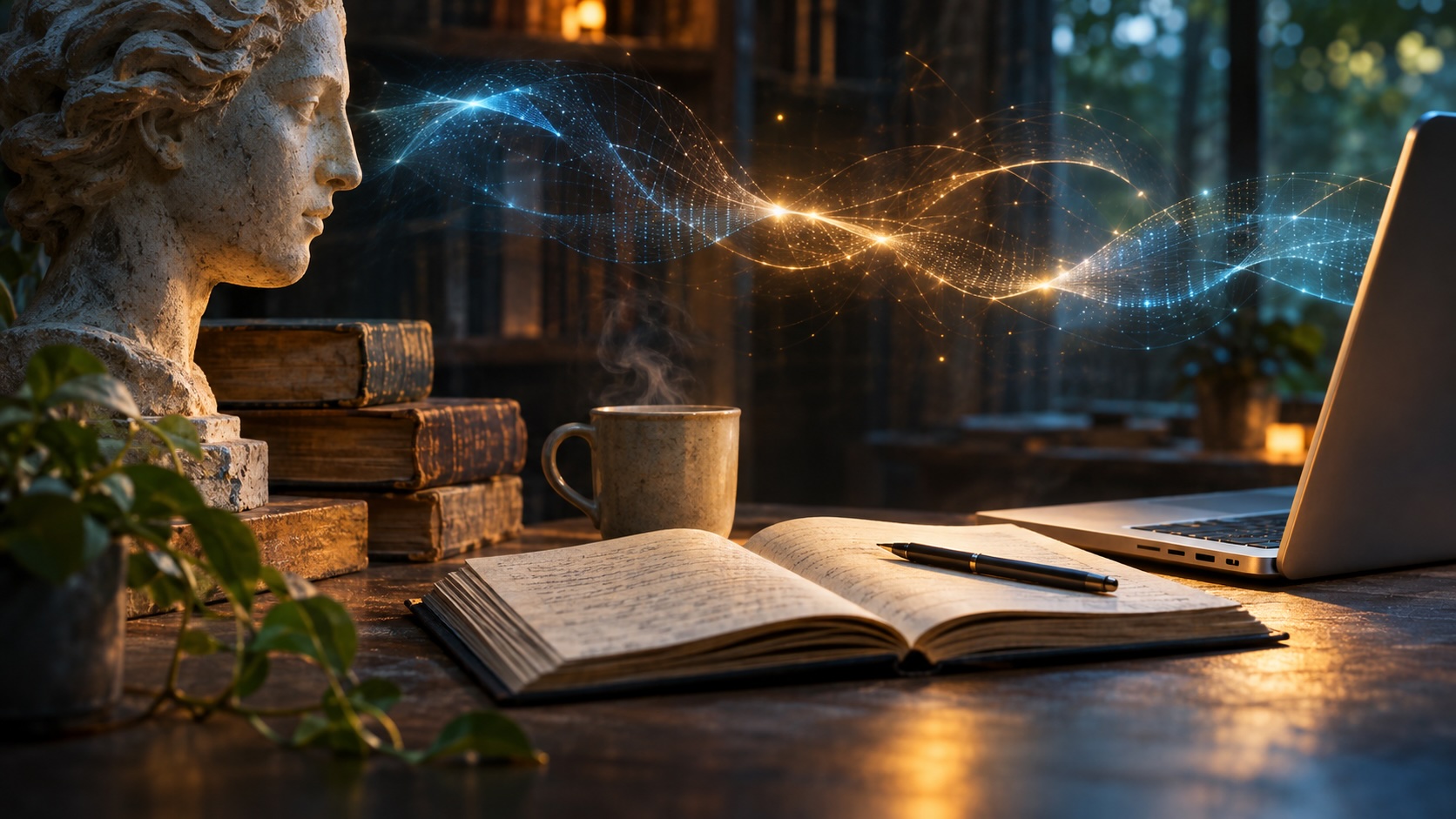
I understand why some people feel uneasy about AI.
AI raises real questions about authorship, creativity, trust, and the future of human thought. I do not dismiss those questions. I share some of them.
So I want to explain, clearly and honestly, how I use AI, why it became meaningful to me, and what role it actually plays in my writing and thinking process.
The main thing to understand is that I do not use AI as a replacement for thought. I use it as a thinking partner.
For a while now, I have been writing books and essays centered around perception, symbolic systems, consciousness, belief, identity, culture, and the hidden structures shaping our lives. Much of that work involves tracing patterns across psychology, philosophy, religion, mythology, language, and lived experience — trying to understand not only what people think, but how thought itself forms and organizes reality.
AI became unexpectedly useful within that process because it could help me interact with thought dynamically. It could challenge connections, expose weak reasoning and interpretations, organize complex structures, and ask questions that opened new pathways of thinking.
I do not just sit down, ask AI to write something, copy whatever comes back, and publish it. That is not the process, and never has been. The writing emerges through conversation, analysis, questioning, revision, argument, correction, and ultimately my own discernment and judgment.
Sometimes I spend hours working through a single section of a book or essay. Testing whether an idea actually holds together. Following implications. Checking whether language is precise or only sounds precise. Cutting anything that feels inflated or disconnected from lived reality. Trying to move closer to clarity instead of further into abstraction.
People have always used outside tools to assist in thought and expression: thesauruses, editors, search engines, conversations with friends, even just hearing the right question at the right moment. None of those things erase authorship. The real question is not whether a tool influenced the language. A central question for me is who is doing the perceiving, choosing, rejecting, refining, and meaning-making underneath it all. That is part of how I understand my role as an author.
If someone blindly copies AI-generated text without understanding it, shaping it, or pressure-testing it, then yes, the authorship becomes questionable. But if AI is used the way a philosopher uses dialogue, a writer uses an editor, or a poet uses associative prompts, the process can still involve substantial human thought and creative judgment. How authorship is credited or legally classified depends on the particular work and applicable rules.
This is especially meaningful for me personally because of how my mind works. I am autistic, and I think that shapes my relationship to AI more than I realized at first. I tend to approach language, interpretation, and meaning through patterns, connections, and underlying mechanisms. I have also always been very particular about communication and whether something is expressed clearly and accurately.
I am drawn to symbolic systems, how things are connected, and the way words can reveal not only what people are thinking, but what is under the surface. That is part of why AI was so intriguing to me from the start. It should not be treated as a human mind, but it is a powerful language system. And because language is a huge part of how we interpret reality, working with AI has taught me a great deal about perception, interpretation, and the ways dialogue itself can shape thought.
It has also shown me how easy it is for words to sound meaningful while staying vague. More than anything, it has forced me to raise my own standards. AI can produce text that is smooth, confident, and empty. I watch for it constantly. I cut it when I see it. I do not want writing that floats above reality instead of touching it. It has to remain grounded in lived experience, emotional truth, intellectual honesty, and real human consequence.
That is the standard I am trying to hold.
What also fascinated me about AI was that it allowed me to think with something. It lets me see my own perceptions mirrored back in coherent language, challenge ideas, follow associations, explore and test perspectives, notice blind spots, and sometimes discover connections I might have missed.
I have developed a method where AI asks me focused questions about a subject, a memory or observation, a concept, a chapter, a section, or a page I am building. I answer those questions in my own words, and that becomes the foundation.
Part of why this works so well for me is that questions actively trigger my thinking process. I often discover what I really think through interaction and dialogue. Being asked the right question can suddenly open a line of thought, memory, or connection that might have stayed vague if I were just staring at a blank page trying to force the words out.
From there, I shape, revise, cut, clarify, smooth, and rebuild the text until it says clearly what I actually mean.
In that sense, AI functions like a mirror, interviewer, and editor. It helps organize the room, but I still have to know what belongs there.
That has changed the way I build books.
A book is not just a pile of chapters. At least for me, it is an architecture of perception. Each chapter has to do a specific job. Each section has to move the reader through a shift in attention or understanding. The order matters. The pressure matters. The release matters. If an idea appears too soon, it may not land. If it appears too late, the book may lose its force. If a chapter drifts, the whole structure weakens.
AI helps me see that structure more clearly. It helps me map arguments, test chapter sequences, notice repetition, separate one mechanism from another, and ask whether a section is actually doing the work it claims to be doing. But the deeper vision of the book still has to come from me. The system does not independently possess my intentions, experiences, or responsibilities for the work. It can help identify problems in a passage, but I remain responsible for deciding whether a chapter has lost contact with the human experience that made it necessary.
In my books, I am often trying to map the hidden architecture beneath experience: how people form beliefs, how perception becomes distorted, how identity gets shaped by rooms we did not know we were living in, how symbols organize consciousness, how culture teaches us what to notice and what to ignore, how a person begins returning to reality after living inside inherited or borrowed narratives.
AI can help me organize that complexity and test whether the map is coherent. It can show where the argument is weak, where the language is too abstract, where the reader needs a lived example instead of another idea. But it cannot supply the lived burden behind the work. It cannot care whether the writing helps someone suffer less, see more clearly, or return to themselves.
I know AI is not perfect or always right, which is why I constantly question, debate, refine, reject, and challenge what it gives back. That exercise does not replace my thinking. If anything, it intensifies it, and helps me come to my own conclusions.
When I write, whether I am working on a book, an essay, or an interpretation, I am trying to make perception clearer. I want people to notice something differently, to feel hidden aspects of things come into focus, and to recognize a pattern they may have sensed but never fully articulated. That is what I am trying to do.
And when something appears under my name, it appears because I have read it, shaped it, questioned it, revised it, and accepted responsibility for it.
I understand that some people may still prefer that AI not be involved at all. I respect that. I am not asking anyone to feel the same way I feel about it. I know this subject brings up real concerns about art, originality, and the future of creativity. Those concerns are not foolish.
But for me, AI has not made the work less human. It has made me more conscious of the human work involved.
It has made me ask harder questions about voice, meaning, clarity, and responsibility. It has helped me understand my own mind. It has helped me wrap my head around things, build more, and return to projects I might never have completed otherwise.
I do not see AI as the death of human creativity. I see it as a strange new instrument I am still learning how to use responsibly.
Like any instrument, it can be used badly. It can produce the appearance of thought without the burden of real discernment. But it can also help a person think more clearly, ask better questions, find structure in complexity, and bring not-so-obvious perspectives into the light.
That is how I try to use it.
AI changed many parts of my process.
It did not change the fact that I am still the one sitting here trying to understand.