
The Human Return Library
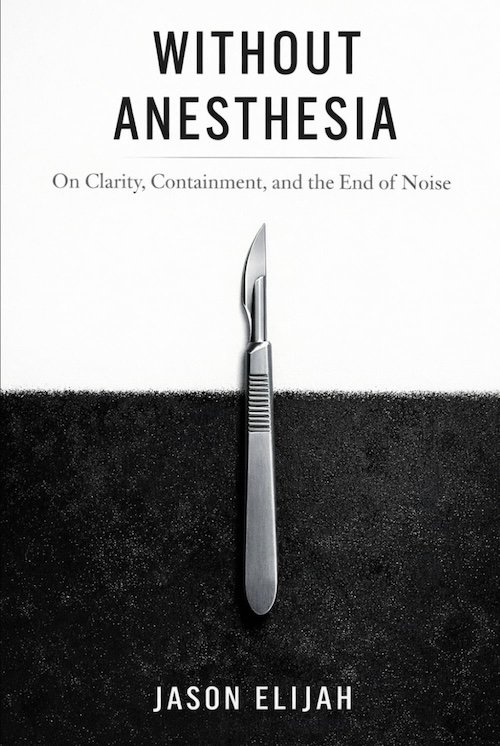
WITHOUT ANESTHESIA
On Clarity, Containment, and the End of Noise
Most mental activity functions as anesthesiaAvailable on Amazon ↗
rather than inquiry.
About the book
Without Anesthesia begins with a simple, unsettling idea: much of what people call thinking is not inquiry at all. It is movement. Pressure looking for release, narration trying to reduce sensation, noise covering a quieter hum underneath.
The book looks at what happens when that noise is no longer trusted. It traces compulsive thought, urgency, self-monitoring, emotional discharge, and the pressure to turn experience into language before it has fully settled. It explores the difference between real insight and mere momentum.
Without Anesthesia is not a book about self-expression or catharsis. It is less interested in relief than in attention. It asks what becomes possible when attention is no longer used to thin experience, discharge pressure, or keep the self busy with itself.
From there, the book turns toward restraint as containment rather than repression. It examines silence, privacy, solitude, and discipline as conditions that preserve structure. In this view, not everything true needs to be spoken. Not everything intense needs to be shared. Not every internal movement deserves to be followed. What is held cleanly gathers force. What no longer leaks becomes clearer.
As the noise drops, another kind of perception becomes possible. Thinking slows. Seeking softens. Experience no longer needs to be explained immediately in order to be tolerated. Sensation becomes simpler. The body notices before the mind begins its commentary. Silence is no longer emptiness waiting to be filled, but structure. Privacy is no longer secrecy, but care. Solitude is no longer loneliness, but the removal of interference.
The book does not rush toward revelation or try to move the reader into a preferred state. It becomes quieter as it goes: more exact, more spare. The movement is not toward transcendence, but toward contact — the direct meeting of what is real, without anesthesia, and without the usual protective blur that stands between a person and their own life.
At the center of the book is a different understanding of clarity. It is not intensity or certainty, and it is not the speed of an answer arriving. It is the reduction of distortion and compulsive explanation. When that happens, orientation begins to emerge on its own. Action no longer needs a large story behind it. Speech no longer needs urgency in order to carry weight. What is true arrives with less noise around it.
By the final movement, the book opens into a portrait of a life lived without anesthesia. A life with less management, less self-medication through thought, less dependence on relief as a substitute for truth. What remains is not bliss, but availability. A person not as easily pulled off course because attention is no longer constantly leaving itself.
What emerges is a vision of clarity that is unsentimental, disciplined, and deeply humane. It does not soften reality; it meets reality directly. It does not promise comfort; it refuses to confuse comfort with contact.
The mind does not become useful by moving more.
It becomes clear when it no longer needs to keep escaping itself.
Read an excerpt from this book
Chapter 1
The Static Beneath Thought
Most people believe they are thinking.
What they are noticing is something else.
A background agitation.
A low, constant pressure.
A sense that something is unfinished.
This hum is present before any particular thought appears.
It does not argue.
It does not speak clearly.
It insists.
It insists that something must be resolved.
That something is missing.
That stillness would be a mistake.
When the mind is quiet, this pressure becomes
more noticeable, not less.
Silence exposes it.
This is why stillness feels threatening at first.
Nothing is wrong.
But the noise that usually covers the hum
has dropped away.
Thoughts rush in to relieve the pressure.
Plans. Memories. Questions.
They restore motion.
The relief is temporary.
The hum remains.
Most mental activity is not inquiry.
It is discharge.
The mind moves to avoid feeling unresolved.
It produces content to justify its own momentum.
This is mistaken for intelligence.
Nothing has been examined yet.
Nothing has been decided.
Only the static has been covered over again.
And when the covering fails, the movement resumes.
This is called thinking.