
The Human Return Library
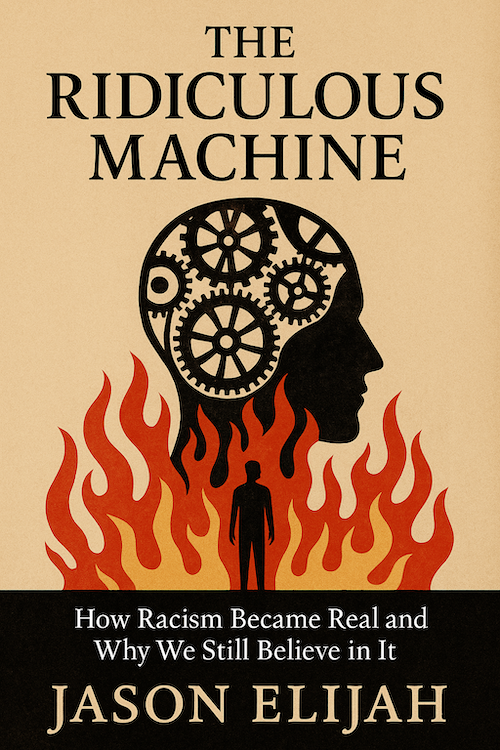
The Ridiculous Machine
How Racism Became Real and
Why We Still Believe in It
Race was built to solve a problem, not to tell the truth.Available on Amazon ↗
About the book
The Ridiculous Machine begins with a recognition many people once had as children before the world taught them to doubt it: race does not make sense. Its categories feel forced. Its logic scrapes against reality. Something in the human mind knows, before it learns to go along, that the whole structure is absurd.
This book follows that absurdity all the way down. It traces how a fiction became an institution, how an invention hardened into law, and how law hardened into neighborhoods, schools, habits, reflexes, fears, and stories so familiar that whole societies forgot they had ever been chosen. What we call race is approached here not as an ancient truth or natural human instinct, but as a designed system — a solution to political and economic problems that powerful people did not want to name honestly.
Because of this, The Ridiculous Machine does not reduce racism to individual hatred or personal prejudice. It looks at the larger mechanism. The stories that became laws. The laws that became structures. The structures that became common sense. The result is a world in which inequality can keep reproducing itself even when many of the people inside it no longer think of themselves as believers in hierarchy. The machine keeps moving because it has been built into the defaults.
From there, the book turns outward. It explores the invention of race in colonial law, the pseudo-scientific mythology of difference, the architecture of inequality, the curriculum children absorb before anyone speaks openly, and the way nations edit memory in order to protect innocence at the expense of truth. Again and again, the same pattern appears: an invention becomes structure, and the structure teaches the invention back to the culture until it feels like weather instead of design.
But the book is not only historical or structural. It also moves inward. It examines the psychology of othering, the need for coherence, the reflex to project fear onto difference, and the way identity itself can become organized around stories that feel stabilizing even when they are false. The book refuses simplification. It does not hunt easy villains. It asks what human beings do under fear, how innocence becomes complicity through repetition and omission, and why some lies become so socially useful that entire civilizations begin to breathe them.
Yet for all its seriousness, The Ridiculous Machine does not end in accusation or despair. It turns, carefully, toward what happens when the story begins to lose its grip. When children are told the truth instead of the edited version. When adults stop mistaking discomfort for danger. When memory becomes honest enough to hold both brutality and resistance. When people learn to see systems instead of only individuals, and to understand that ordinary choices are exactly the scale at which culture is made and remade.
The final movement of the book is toward a new human story. Not one built on guilt, innocence, or permanent roles, but one grounded in reality, repair, and a more truthful account of human life. fiction with devastating effects. Once the machine is named clearly enough that it can no longer pretend to be natural.
What emerges is a book about racism, but also about memory, perception, courage, and the strange human capacity to believe in absurdities until someone sees through them plainly enough to begin changing the room.
The machine was built by human beings.
That means human beings can stop feeding it.
Read an excerpt from this book
Prologue
The First Time You Saw It
Before anyone explained a thing to you, the world simply was. Its colors were colors, not categories. Its people were people, not symbols. Its differences were the ordinary texture of being alive — the way hair curls or doesn’t, the way laughter rises from different throats, the way sunlight warms every face without distinction. The world arrived whole, unsegmented, uninterpreted. And then, one day, someone tried to hand you a story that did not fit the shape of your mind.
You can still feel the moment its edges scraped against your awareness: a grown-up voice, confident and casual, offering a sentence you were expected to accept as truth. A sentence about who belongs where. A sentence about who is “like us” and who is not. A sentence wrapped in the authority of adulthood, delivered in the tone of someone who believes they are simply passing along the way things are — when in reality they are repeating something they themselves inherited without reflection.
You didn’t have the language for it, but you recognized the absurdity instantly. Children are naturals at spotting nonsense. You had not yet learned how to perform agreement to protect someone’s feelings. You had not yet learned how to bend your inner knowing to the expectations of the room. You had not yet learned that adults cling to certain stories not because those stories are true, but because without them the world might lose its familiar architecture.
So you stood there — small but awake — and did not swallow the myth being presented as fact. Something inside you whispered a quiet no. It wasn’t defiance, and it wasn’t rebellion. It was clarity.
This is not real.
In that moment, you glimpsed the ridiculous machine...