
Threshold Ten · Desire
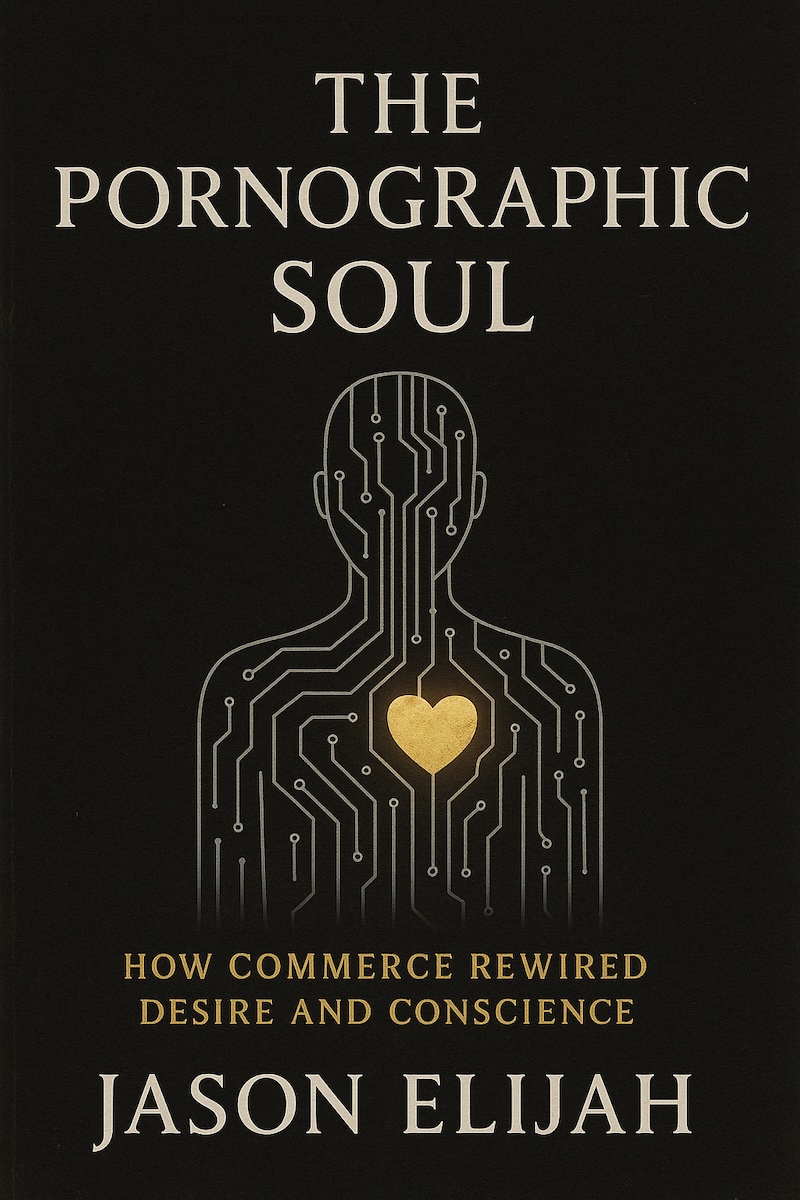
The Pornographic Soul
How Commerce Rewired Desire and Conscience
When desire is extracted for profit,Available on Amazon ↗
the soul learns to disappear.
About the book
It doesn’t begin where people expect.
Not with sex. Not even with pornography.
It begins with something harder to admit: the way desire changes when no one is really there.
The Pornographic Soul starts from that shift. Not as a moral argument, but as a question: what happens to intimacy when longing is pulled out of relationship and placed inside systems designed to capture, repeat, and sell it?
This book follows that transformation closely. What once required presence becomes available in absence. What once involved another person becomes something that can be accessed, repeated, and replaced. Desire moves from encounter into performance, from mystery into market, from something shared into something consumed.
And something else moves with it. Attention narrows. Empathy thins. The ability to feel another person as real begins to weaken through repetition.
Because of this, The Pornographic Soul does not treat pornography as a private problem or a moral panic. It treats it as a system. A place where patterns of attention and desire become easier to see.
The same mechanisms that organize desire—stimulation, visibility, endless novelty, algorithmic reinforcement—do not stay contained. They begin to show up elsewhere: in social media, in self-image, in loneliness, in the performance of identity.
The book stays close to lived experience: the glow of a screen in an otherwise empty room, the moment after stimulation when nothing has actually been met, the slow replacement of touch with image and presence with performance.
From there, it turns toward the structure beneath it. Platforms that learn to keep people slightly unmet, slightly restless, slightly wanting—because wanting is profitable. Desire becomes data. Attention becomes inventory. Bodies become content.
But the book does not remain at the level of critique. It moves into the human cost: coercion, humiliation, dissociation, and the splitting that occurs when arousal is separated from empathy. For viewers, performers, and anyone caught inside a system that can simulate connection without ever holding it.
It also stays with something more difficult: the places where people were, in some way, finally seen. And the truth that being seen inside an extractive system is not the same as being protected, held, or loved.
What lives underneath this is rarely simple lust. It is loneliness. Relief. The wish to be wanted, to be received without shame, to be touched without fear, and to matter to another body.
What the system does is intercept that longing, routing it into forms that can stimulate it endlessly without ever allowing it to be fulfilled.
Still, this is not a book of condemnation. Its final movement turns toward return: desire rejoined with empathy, with consent, with the gravity of one person actually meeting another.
The body is not rejected. It is remembered.
This is where the book becomes more demanding. It asks how to feel without numbing, without replacing, without turning away. It asks what pleasure becomes when it is no longer separated from tenderness. It asks whether intimacy can survive the systems built to simulate it.
And it answers without surrender: something in us still knows the difference.
The Pornographic Soul is not anti-desire.
It is against the forms of freedom that leave a person visible, stimulated, and profoundly alone.
The body was never meant to be content.
It was meant to be met.
Read an excerpt from this book
Introduction
The Mirror and the Machine
There was a time when desire spoke softly. It was not a product, not a performance, but a pulse — a language older than words. The earliest lovers carved its syllables into stone and song. They knew that to touch was to pray, that the body was a scripture written in warmth and breath. Desire was not yet a marketplace. It was a mystery — the soul remembering itself through another’s nearness.
The ancients called that current Eros — not merely lust, but the gravity of love, the energy that draws all things toward communion. Eros is the pulse that binds self to world, body to spirit, you to me. To mistake eros for mere arousal is to confuse lightning with the flashbulb that imitates it. But every prayer, once overheard by power, becomes currency.
When pleasure could be sold, reverence was stripped from it. The sacred became spectacle. The first cameras learned to hunger, and the first audiences learned to forget. A photograph replaced a person; a reel replaced a ritual. What once required presence could now be consumed in absence. By the time the algorithm arrived, eros had been rewritten in binary — every body translated into data, every longing into a statistic. We no longer made love. We streamed it.
Pornography is not the sickness of civilization. It is the symptom, the mirror that reveals what civilization has become. Each pixel, each transaction, each isolated climax is a record of the human experiment: What happens when intimacy is divorced from empathy, and pleasure is engineered without conscience?
This book does not aim to shame anyone. Shame is part of the machinery we must dismantle. The inquiry here is subtler and more courageous: How did we come to confuse stimulation for connection, performance for intimacy, domination for desire?
Yet beneath the circuitry, something sacred endures. There is still a pulse under the numbness, a tenderness under the code. Even now, the body remembers what awe feels like. Even now, the soul aches for touch that is not transaction.
The erotic, in its truest form, is not spectacle but communion — the current of life seeking to know itself through love. It is the electricity of empathy, the divine intelligence of tenderness. It refuses to die.
To read this book is to look into the mirror and see not filth, but fracture: the place where love fell out of its own image. The task is not to avert your gaze, but to let it deepen — until truth becomes touch again.
Beneath the static hum of the machine, a quieter signal persists. It is the hum of life remembering itself — not as image, not as brand, but as breath.