
The Human Return Library
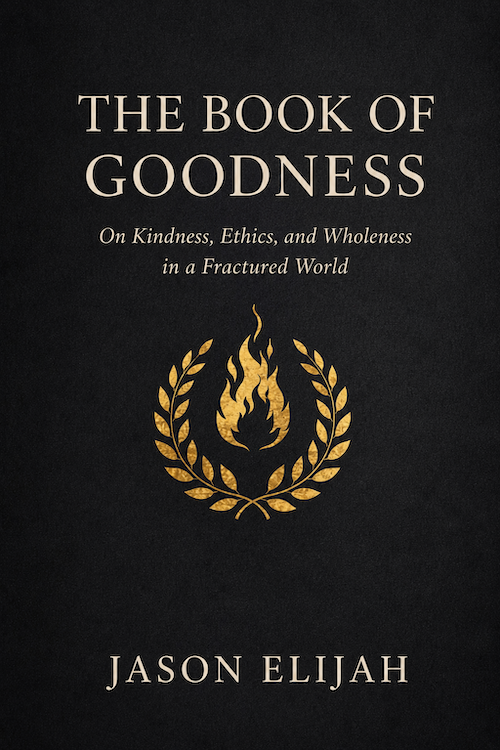
The Book Of Goodness
On Kindness, Ethics, and Wholeness in a Fractured World
Goodness is not a virtue to achieve,Available on Amazon ↗
but a condition that must be preserved.
About the book
The Book of Goodness begins with a problem many people know but do not always know how to name. They try to be good. They try to be thoughtful, patient, understanding, responsible. And over time, instead of becoming steadier, they begin to lose themselves.
The book traces how that happens. It follows goodness through family, religion, psychology, power, and modern social life, showing how moral ideas that once helped people live together can become distorted. Care can turn into compliance. Restraint can turn into suppression. Kindness can turn into self-erasure.
Rather than treating goodness as a personality trait or a moral identity, the book approaches it as something that depends on inner and relational coherence. It asks a different question from the one people are usually taught to ask. Not simply, “How do I be good?” but: how does a person remain whole while acting ethically in a complicated world?
From there, the book moves outward. It looks at how empire, religion, psychology, capitalism, and performance culture have shaped what people think goodness requires of them. The same pattern appears repeatedly. Systems often reward forms of goodness that make people easier to manage, quieter to control, or more willing to betray their own perception in order to belong. Goodness becomes less about integrity and more about obedience, image, or emotional accommodation.
But The Book of Goodness does not stop at critique. It turns toward recovery. It looks closely at boundaries, refusal, accountability, repair, and the difference between niceness and real kindness. It argues that real goodness includes limits, truth, accountability, and the strength to protect what matters without hardening into cruelty.
At the center of the book is a simple but difficult recognition: goodness that requires the loss of the self cannot remain goodness for long. It eventually turns into resentment, performance, collapse, or quiet harm. A more durable form of goodness has to include wholeness. It has to let a person care without disappearing, tell the truth without domination, and repair without self-betrayal.
Because of this, the book speaks to two kinds of readers at once. It speaks to those who have tried to be good and ended up exhausted. It speaks equally to those who have grown suspicious of goodness altogether because they have seen how easily moral language can be used as control. The book does not flatter either position. It asks what these ways of living actually do to a person over time — in the nervous system, in relationship, in perception, and in the possibility of rest.
The result is not a book about moral perfection. It is a book about ethical life that can endure without becoming brittle, theatrical, or cruel. It does not divide the world into good people and bad people. Instead, it returns to consequences, asking which forms of goodness preserve a person, and which ones fracture them.
What emerges is a vision of goodness that is firmer, cleaner, and more human than many people were taught to expect.
Goodness not as performance, but wholeness.
Read an excerpt from this book
Prologue
Why Goodness Needs to Be Rescued
I want to start with something simple. Most people who care about being good are tired. It is the quiet kind of tiredness. The kind that shows up as a smaller voice, a delayed reply, a slow retreat from conversations that used to feel easy. The kind that makes you wonder, privately, whether goodness is something you’re built for, or something you keep failing at.
That tiredness does not mean you lack a moral spine. It could be that you’ve been carrying a version of goodness that required you to disappear.
A lot of us inherited definitions of goodness that were incomplete. They were not always malicious or intentionally cruel. But they were incomplete in ways that become brutal over time. They taught us to be agreeable when we needed to be clear, to be understanding when we needed to be firm. They taught us to confuse self-erasure with virtue, and then they called our resentment a personal flaw.
You can live like that for years. You can even build a whole identity around it. You can become dependable, admirable, generous, “easy to be around.” And then one day you notice something that doesn’t fit the story. You notice a small hardness in you that wasn’t there before. A tiny flinch when someone needs something. A little spike of irritation at kindness itself. You notice that you’re doing the right things, but you’re not resting inside them.
That’s one side of the problem.
The other side is harder to say out loud, and it’s one reason this book has to exist at all. There are hidden costs to being cruel, dominating, or always needing to win. The cost does not need to be cosmic, divine, or theatrical.
It shows up in the body, in attention, and in the way life feels when no one is watching.
Some people hear of a book about goodness and immediately translate it as weakness. A support group with better prose. A hymn to niceness. A gentle request to become smaller and less real. If you’ve ever had that reaction, or if you’ve ever been close to someone who had it, I understand the instinct. Niceness can be fake. Softness can become performance. “Goodness” can be used as a leash.
But this book is doing something different.
It is not defending goodness as an identity. It is asking what kind of inner structure allows a human being to rest without needing to guard, posture, manage, or dominate.
Because domination has a cost too, even when it works.
Many people will never admit that. Some have built an entire identity around avoiding the admission. But the signs show up anyway, usually in small places. The scanning for disrespect. The inability to relax in kindness because kindness feels dangerous. The way triumph needs an enemy to stay meaningful. The way pleasure thins out when it has to be mixed with contempt to feel strong. The way “winning” sometimes leaves a strange emptiness behind, like eating something salty when what you actually needed was water.
There’s a moment some people know well, even if they would never confess it. You win an argument. You say the sharp thing. You land the point. You watch the other person go quiet. You feel the shift. Control returns. Then later you’re alone in the car, or standing at the sink, or staring at the ceiling, and the win doesn’t taste like anything. It doesn’t settle or restore you. It only confirms that you’re still on watch.
That is information, not shame.
This book is built on that kind of information. The kind you can’t talk yourself out of. The kind you can feel in your nervous system if you are willing to notice it.
Goodness has been framed, again and again, in ways that served power, harmony, and purity at the expense of the self. Sometimes it served institutions. Sometimes it served families. Sometimes it served a social order that needed people compliant, quiet, self-denying, and easy to manage. Sometimes it served a culture that rewarded performance over integrity. And sometimes it served a fear of conflict dressed up as compassion.
Because of that, many people who genuinely want to be good have come to associate goodness with shrinking. With smiling through something that harms them. With never making things difficult and always being the one who adapts.
But there’s another possibility.
What if goodness, in its real form, was never meant to require self-erasure? What if goodness originally included limits, refusal, protection, and accountability as part of the design? What if goodness without boundaries is not goodness at all, but a slow surrender that eventually turns into resentment or quiet harm?
And what if badness, in its real form, isn’t strength either? What if it’s a strategy that promises relief while quietly producing fragmentation? What if it works socially, sometimes brilliantly, while sabotaging the very thing people are actually searching for when they reach for power in the first place, which is rest?
I’m looking at this from inside the question, not above it. I took goodness seriously enough to question it when I saw what it was doing to people, including me. I saw how easily goodness becomes performance and how often empathy is used to avoid clarity. I saw how frequently “being the bigger person” becomes a polite name for abandoning yourself.
I also saw the other side. How hardness can become addictive. How control can become a kind of hunger. How contempt can masquerade as intelligence. And how those states slowly narrow a person until life becomes smaller than their own self-image.
None of this makes anyone a villain. It makes us human. Patterned. Capable of telling ourselves stories that keep us moving while the body keeps score in quieter ways.
So this book is not asking the familiar moral question, “How do I be good?” as though goodness were a personality type or a badge someone earns.
It’s asking something more grounded.
How do I remain whole while acting ethically in a complicated world?
Because wholeness is not a luxury, an indulgence, or a self-help ornament. It is the condition under which ethical responsibility can last without turning brittle, performative, resentful, or cruel.
There are two kinds of pain that matter in this territory. There is the pain of distorted goodness: the pain of disappearing, of swallowing truth until your own voice starts to feel foreign to you. And there is the cleaner pain of real goodness: restraint, refusing the quick win, telling the truth when it costs you something, choosing repair over pride, walking away from an addictive superiority. That pain is not burnout. It is integrity under pressure.
If you have been sincerely trying to do the right thing and you are tired, I want you to feel something here that moral conversations rarely provide. Relief. Relief without abandoning responsibility. Relief from confusion, from the suspicion that your need for limits makes you selfish, from the idea that refusing harm is unkind, and from the belief that you must remain endlessly accommodating in order to deserve being called “good.”
And if you’ve lived on the other side of the equation, if you’ve leaned on sharpness, control, contempt, or simply dismissed goodness as naïve, persuasion is not the point here. I’m trying to describe reality clearly enough that you can recognize yourself without feeling cornered. Because recognition is stronger than argument. It changes people without asking permission.
This book will not divide the world into good people and bad people. It will not flatter anyone’s identity or hand you a moral costume to wear. It will keep returning to consequences, to what different ways of living do to the inner life over time, to what they do to the nervous system, to perception, to relationship, to the possibility of rest.
By the end of this prologue, I want one thing to be clear.
The deeper question is not who belongs in the category of good or bad, but which ways of living allow a person to remain intact.
That’s where the inquiry begins.