
The Human Return Library
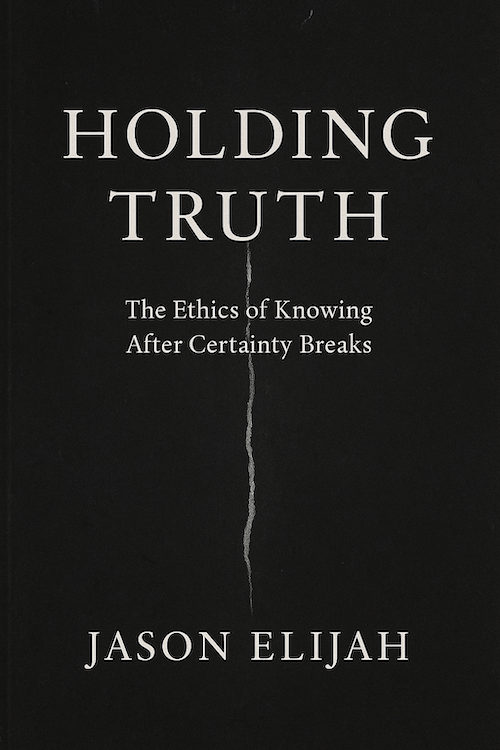
Holding Truth
The Ethics of Knowing After Certainty Breaks
Truth can remain accurate while becoming dangerous in how it is held.Available on Amazon ↗
About the book
Holding Truth begins in a moment many people recognize but struggle to name: the moment when being right no longer feels like enough. The facts may still hold. The evidence may still be sound. And yet something has shifted. Correctness no longer guarantees care. Clarity no longer guarantees repair. Truth remains real, but the way it moves through life has become heavier and more consequential.
This book explores what it means to know responsibly after that shift. It does not argue against truth, evidence, or accuracy. It asks a different question: not only, “Is this true?” but “What does this truth do when it moves through people?” What happens when a fact is correct but destabilizing, when knowledge travels faster than care, when being right stops helping and starts dividing, hardening, or wounding?
Because of this, Holding Truth is not a book about winning arguments or replacing one certainty with another. It treats knowing as an ethical activity. Truth is not approached as something to display or defend, but as something carried inside relationships, institutions, and human lives. The question is no longer just whether something is accurate, but whether it is being carried responsibly.
From there, several important distinctions begin to emerge. It explores the difference between accuracy and responsibility, between truth and weaponry, between conviction and care. It asks what beliefs are actually doing once they leave the mind and begin shaping decisions, policies, loyalties, and emotional worlds. Some beliefs decorate a life. Others hold it up. Some truths illuminate. Others are used as pressure. The difference is not only in the content, but in the way they are held.
As those distinctions deepen, certainty itself begins to feel more complicated. Truth has not disappeared, but being correct no longer automatically resolves conflict, restores trust, or repairs harm. In that environment, the reader is asked to become more careful, slower, and more responsible for what they know.
This gives the book its particular tone. It does not rush to reassure. It does not hand the reader a new ideology to replace the old one. Instead, it moves toward a more adult form of knowing, one that can remain truthful without becoming coercive, humble without collapsing, and clear without pretending that fracture has been solved. The world it describes is one in which reality no longer feels as settled as it once did, and where integrity depends less on final answers than on the discipline of careful holding.
By the later chapters, it turns toward a more restrained form of strength, asking what it means to hold truth without forcing it, to speak without turning speech into pressure, to stay present when certainty fails to arrive, and to remain intact when all that is left is careful attention and the refusal to turn uncertainty into violence. This is endurance. It is the ethical work of remaining human when truth no longer arrives with consensus attached to it.
What emerges is a vision of truth that is neither brittle nor vague. Not truth as armor. Not truth as status. Not truth as a weapon to win with. Rather, truth as something weight-bearing. Something that must be carried with proportion, humility, timing, and care.
The aim is not to become less honest.
It is to become honest in a way that life can survive.