
The Human Return Library
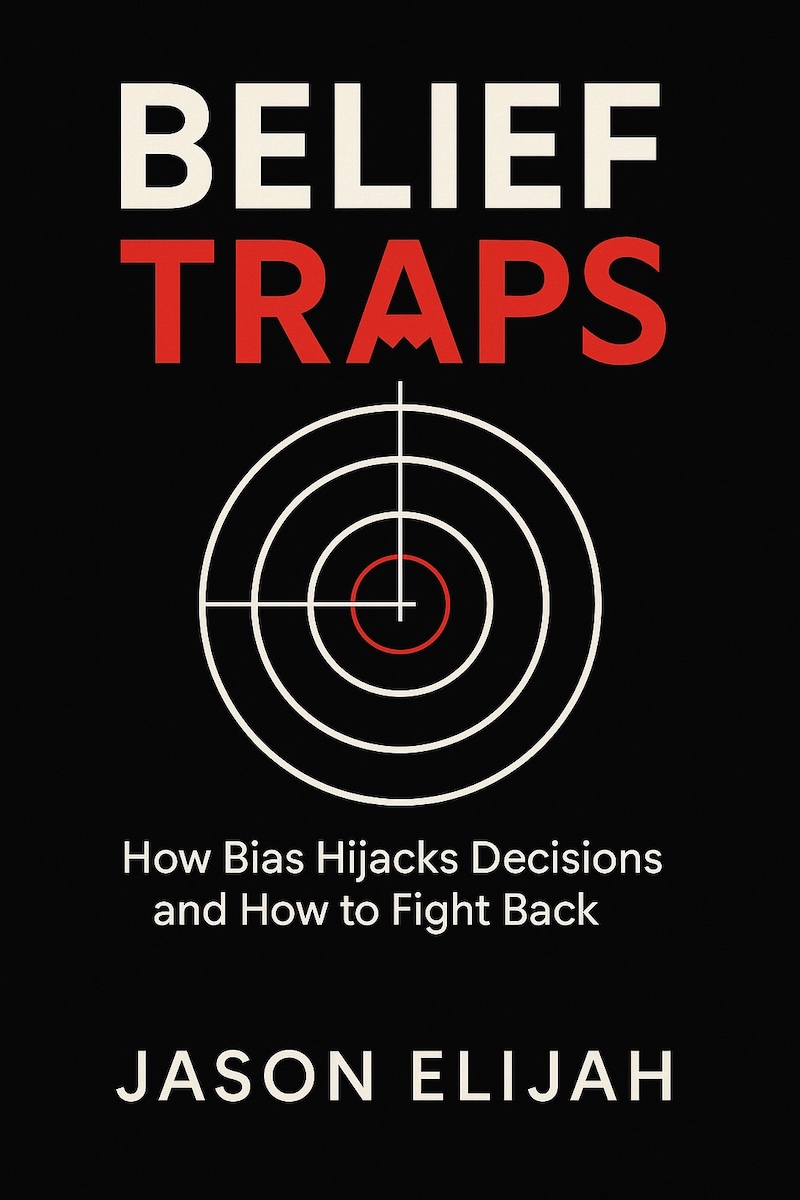
Belief Traps
How Bias Hijacks Decisions and How to Fight Back
Belief forms before evidence, and once formed, it quietly resists correction.
About the book
Orientation
Belief Traps is a structural examination of how human judgment is systematically distorted by the very cognitive mechanisms that enable thinking. The book does not argue that people are irrational, misinformed, or morally compromised. It treats bias as an adaptive feature of the human mind that becomes hazardous under modern conditions of scale, speed, and abstraction. The central problem addressed is not error itself, but the invisibility of the processes that generate conviction. Rather than offering opinion, critique, or social commentary, the book translates findings from cognitive science, probability, and decision theory into a perceptual framework for understanding how belief is formed, stabilized, and defended. Its stance is diagnostic rather than corrective: it names the mechanisms by which certainty arises and shows how those mechanisms quietly decouple belief from reality. Belief Traps is not a manifesto, a debunking exercise, or a guide to persuasion. It does not attempt to replace beliefs with preferred alternatives. It examines how beliefs come to feel true at all.
Contents
The book examines recurring cognitive distortions that reliably shape judgment across domains such as law, medicine, public policy, technology, and everyday decision-making. Core mechanisms explored include confirmation bias, anchoring, availability, optimism bias, overconfidence, base-rate neglect, and the compounding effects that arise when these mechanisms interact. Each distortion is treated not as an abstract concept but as a functional pattern that can be recognized in lived situations. The text repeatedly distinguishes between evidence and feeling, frequency and salience, accuracy and predictive value, confidence and calibration. Throughout, the book translates statistical ideas into natural frequencies, reference classes, and comparative questions that preserve human meaning while restoring scale. Rather than presenting techniques or prescriptions, the content focuses on making perceptual structure legible. What is examined is not what people believe, but how belief takes shape in the mind.
Architecture
The book is structured as a progressive movement from story to mechanism to internal recognition. Each chapter opens with a concrete human scenario in which judgment feels justified but proves fragile under examination. From there, the underlying cognitive mechanism is named and clarified, followed by an exploration of how institutional environments and cultural practices amplify the distortion. The chapter then turns inward, identifying the subtle experiential cues by which the same mechanism can be felt operating in one’s own thinking. This repeated rhythm is deliberate. Narrative establishes relevance without persuasion. Mechanism provides clarity without reductionism. Internal cues allow recognition without instruction. The sequence of chapters builds cumulatively, beginning with vivid, easily recognized distortions and gradually moving toward more abstract failures of calibration and foresight. The form mirrors the function: perception is widened incrementally rather than overturned.
Effect
The book is structured to reduce reactive certainty rather than to provoke doubt. Its analysis differentiates conviction from calibration, making the processes that generate confidence more visible without disputing conclusions directly. Certainty is treated as a cognitive signal rather than a guarantee of accuracy, allowing judgments to be examined in terms of proportion, comparison, and reference rather than assertion. Rather than promoting skepticism or detachment, the work maintains an orienting stance. Beliefs are not targeted for replacement, but repositioned within a wider perceptual field where uncertainty, scale, and probability can be held without collapse. At the level of orientation, the book emphasizes attentional stability over argumentative correction, clarifying how beliefs are formed and defended rather than instructing what should be believed.
Necessity
This book was necessary because modern life rewards conviction while concealing the machinery that produces it. Institutions increasingly demand rapid judgment under conditions where scale, probability, and uncertainty matter most, yet the cognitive tools required to navigate those conditions are rarely taught in perceptual terms. As a result, error accumulates without being experienced as error. Belief Traps addresses this gap by treating bias literacy as a foundational form of cognitive hygiene. It responds to a world in which miscalibrated belief can propagate quickly, feel righteous, and cause harm without malice or intent. The book exists to name that problem precisely and without accusation. [