
The Human Return Library
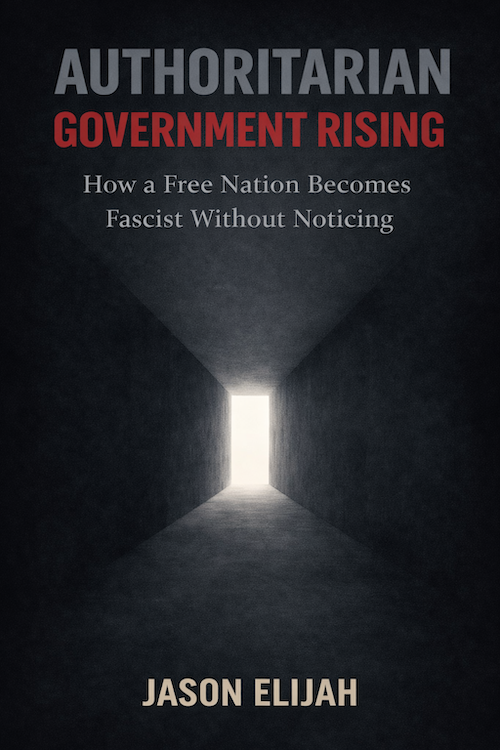
Authoritarian Government Rising
How a Free Nation Becomes Fascist Without Noticing
A free society rarely collapses all at once.Available on Amazon ↗
It is taught, slowly, to stop noticing.
About the book
Authoritarian Government Rising is a study of how free societies begin to turn against themselves without ever fully admitting it. It does not begin with uniforms, coups, or dramatic declarations. It begins earlier, in the subtle changes most people are taught to ignore: a tightening mood, thinning dialogue, a growing hunger for certainty, and the slow emotional bargain by which fear begins to feel more trustworthy than freedom.
The book stays close to that threshold, examining how prolonged crisis reshapes perception, how exhaustion alters moral judgment, and how the promise of order begins to feel like care. In times of instability, people do not usually long for tyranny as such. They long for relief. They want the noise to stop. They want the to feel legible again. That longing is human. It is also where authoritarian power gets its opening.
From there, the book traces the emotional and cultural machinery by which freedom starts to doubt itself. Fear narrows attention. Complexity becomes intolerable. The enemy story begins to form. Language stops pointing toward truth and starts signaling allegiance. Words harden. Dialogue weakens. Public life becomes more performative, brittle, and less able to hold ambiguity without treating it as danger. What looks from the outside like political change is really something deeper: a reorganization of perception itself.
The book does not need to invent larger-than-life villains. Instead, it follows ordinary processes by which ordinary people become participants in systems they would have once distrusted. A frightened population begins asking for answers. A tired culture begins mistaking obedience for maturity. A morally serious public becomes vulnerable to stories that reduce complexity into blame, purity, and the righteous removal of enemies. These are not exotic failures. They are familiar human temptations, scaled up through institutions.
The later movement shifts from psychology into normalization. It explores scapegoating, propaganda, moral intoxication, the emotional rewards of certainty, and the quiet pleasure of feeling unquestionably right. It shows how authoritarian systems do not merely frighten populations. They seduce them. They offer belonging, simplicity, direction, and permission. Permission to narrow empathy, to judge without understanding, to reinterpret cruelty as necessity and control as responsibility.
Control stops looking like control and begins to look like administration, policy, convenience, optimization, and procedure. Authority expands through systems that feel practical and modern. Surveillance arrives smiling. Emergency measures settle into permanent architecture. Participation becomes routine enough that almost no one feels responsible for the whole. The book shows with painful clarity how a democracy may continue to preserve its outer forms while quietly losing its governing substance.
Yet this is not just about political systems. It is also about conscience. The smallest unit of freedom is the human capacity to notice what fear is doing, what certainty is costing, what language is asking us to surrender, and how often obedience feels good before it feels dangerous. Authoritarianism is not something that only happens in governments. It happens in nervous systems, in conversations, in institutions, in habits of thought, and in the countless moments when people become too tired to keep reality in view.
But it does not try to save freedom through hysteria, because hysteria belongs to the very conditions it exposes. Its method is steadier than that. It asks the reader to see. To notice how fear disguises itself as realism, how order can become intoxicating, how moral language can be recruited into domination, and how societies drift toward fascism not only through hatred, but through fatigue, relief, and repeated small abdications.
By the final movement, the book turns toward awakening and resilience. Not in a sentimental or triumphant way, but through the recovery of inner sovereignty, moral attention, shared reality, and the disciplines that keep conscience from being outsourced. It becomes, in the end, a book about the fragile interval before perception fully surrenders. A reminder that freedom survives not only in institutions, but in those who are still willing to notice what is happening while it is still happening.
Democracy rarely dies in a single blow.
It is neglected, normalized, and explained away until almost no one remembers when the closing began.